PLTR · Palantir
Palantir in 2024: a first profitable year and new AI customers
2024 · +340% in the calendar year
For scale: buying every US stock breakout from 2018 to 2026 with no selection returned a median −22.6% a year later, measured on the 14,674 with a full twelve months of data. How it was measured
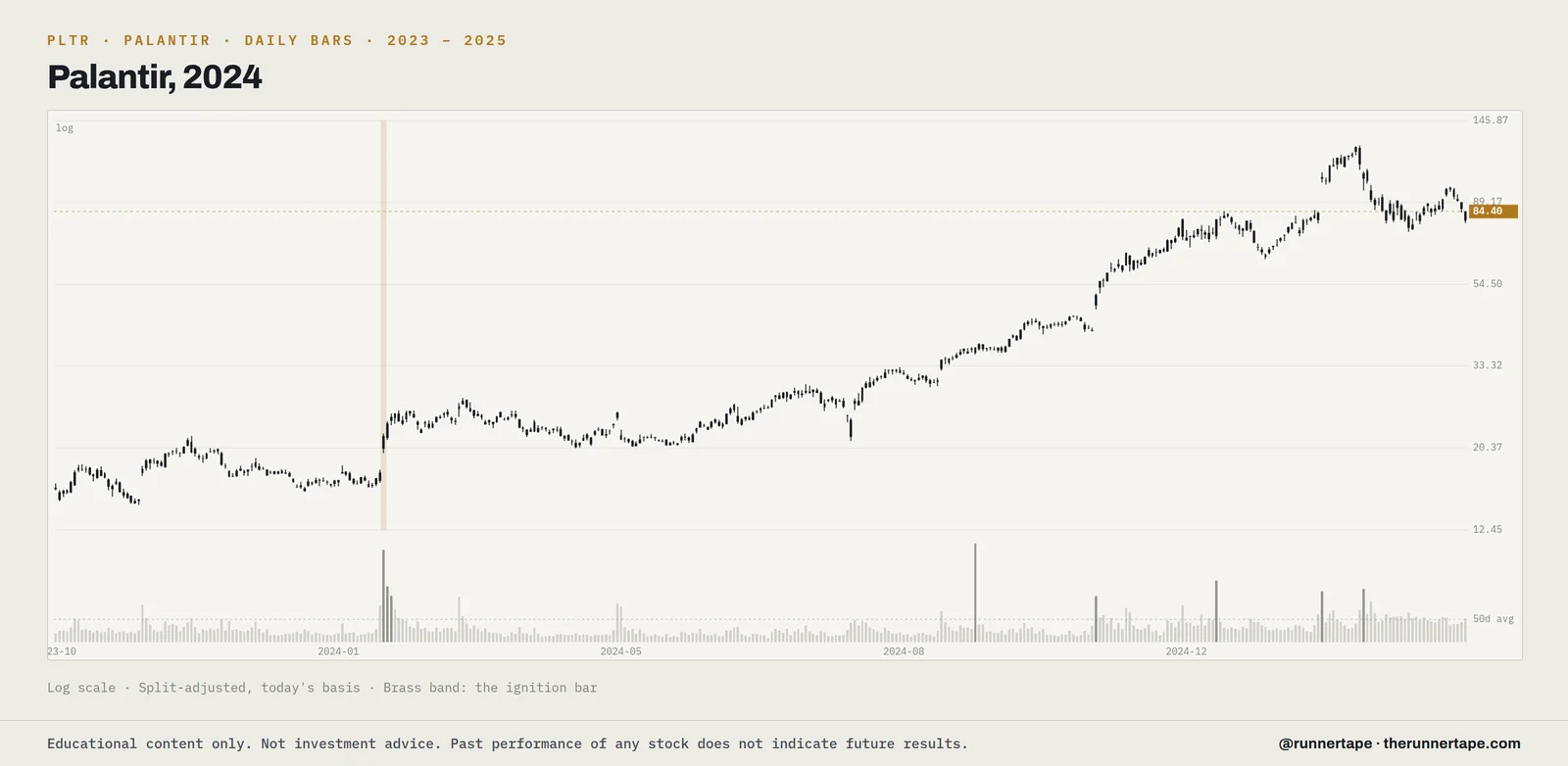
Palantir builds data-analysis software for governments and large companies. Before this run its revenue growth had slowed, and the market doubted that a business which placed its own engineers inside each client could grow like a software company. Its AI platform, sold through short hands-on workshops for prospective clients, began to change that, bringing in new US commercial customers. On 5 February 2024 Palantir reported its first full year of profit, citing strong demand for AI. That report opened the year's move: the share price went +340% in calendar 2024.
Revenue growth kept accelerating, and the stock set a closing high of $207.18 on 3 November 2025, the day it reported quarterly results. It then fell as the market repriced expensive software stocks, although the company had missed no revenue forecast; by 25 June 2026 it was down 40% for the year. In August 2026, after second-quarter results, the stock rose 29% in a single day.
The full replay of this run, every bar with its catalysts pinned, is part of the members' library. Six classic runs are free now, opened by email.
Free: six classic runs
Sources: Bloomberg, 5 Feb 2024 · StatMuse, PLTR all-time high · 24/7 Wall St, 25 Jun 2026 · CNBC, 4 Aug 2026. Price figures are split-adjusted, not dividend-adjusted.
The Runner Tape and its staff hold no financial or other interest, direct or indirect, in PLTR — no shares, no options or other derivatives, no compensation or arrangement of any kind connected with it — and have received no consideration from any person in connection with it being covered here.