LITE · Lumentum
Lumentum 2025: from quarterly losses to 58% revenue growth
2025 · +331% in the calendar year
For scale: buying every US stock breakout from 2018 to 2026 with no selection returned a median −22.6% a year later, measured on the 14,674 with a full twelve months of data. How it was measured
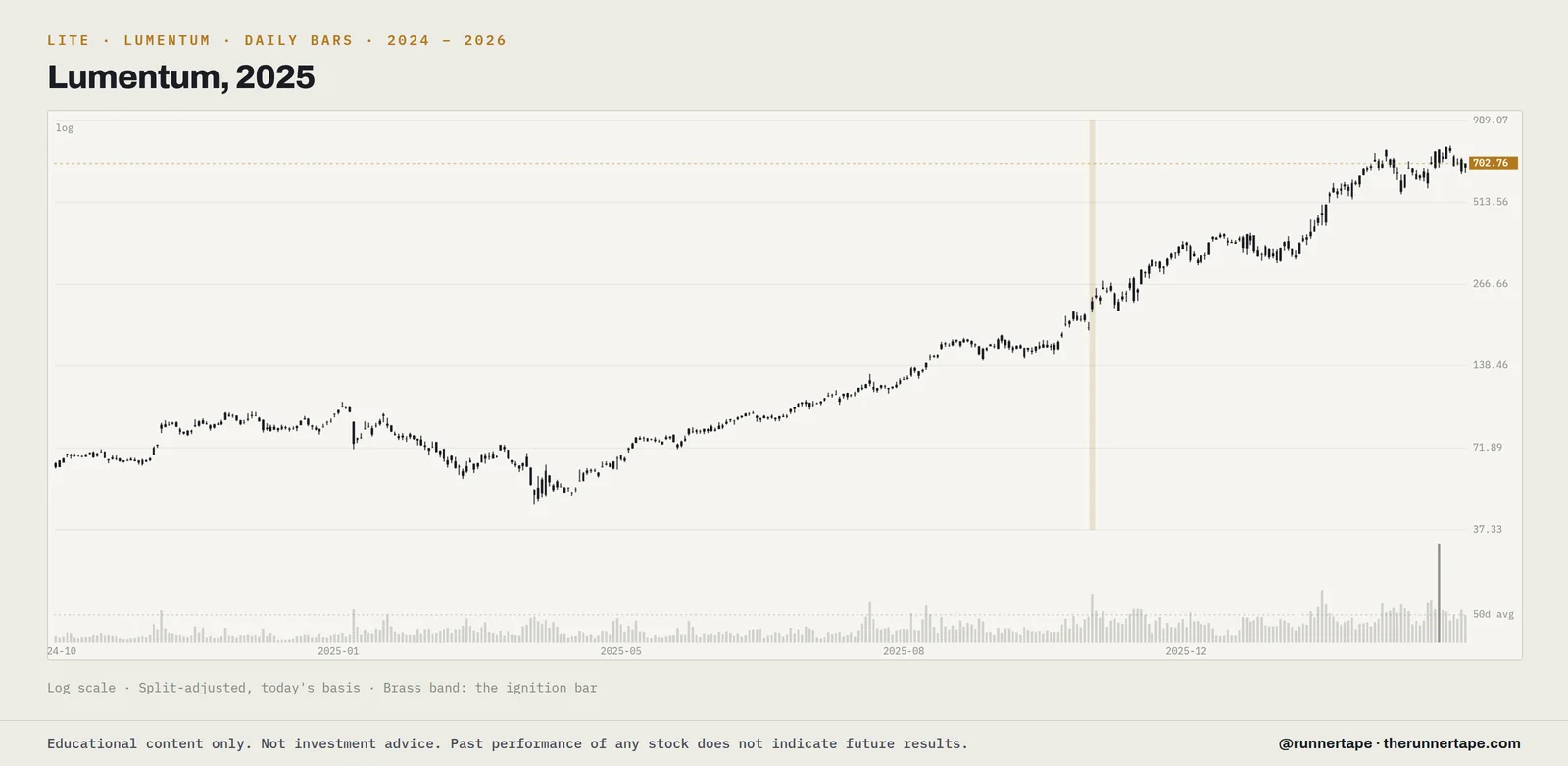
Lumentum makes lasers and optical components for telecom networks and data centres. It entered 2025 after years of losses: in the quarter to September 2024 it reported an operating loss of $72.7 million on revenue of $336.9 million. Its shares fell to an intraday low of $45.65 in April 2025. Revenue then rose each quarter. On 4 November 2025 Lumentum reported quarterly revenue of $533.8 million, up 58% from a year earlier, and guided to more than 20% sequential growth for the next quarter.
The stock finished +331% in calendar 2025. In March 2026 NVIDIA agreed to buy $2 billion of Lumentum convertible preferred stock, alongside a multi-billion-dollar purchase commitment. The shares traded above $1,000 intraday in May 2026, then fell below $600 in July. On 12 August 2026, after fourth-quarter revenue of $1.01 billion, they rose 15% intraday to $942. By 24 August 2026, where this account ends, the stock had not passed its May high.
The full replay of this run, every bar with its catalysts pinned, is part of the members' library. Six classic runs are free now, opened by email.
Free: six classic runs
Sources: Yahoo Finance, 4 Nov 2025 · TIKR, NVIDIA's $2bn Lumentum investment · Yahoo Finance, 12 Aug 2026 · StockAnalysis, LITE. Price figures are split-adjusted, not dividend-adjusted.
The Runner Tape and its staff hold no financial or other interest, direct or indirect, in LITE — no shares, no options or other derivatives, no compensation or arrangement of any kind connected with it — and have received no consideration from any person in connection with it being covered here.