AFRM · Affirm
Affirm in 2023: faster growth and positive adjusted operating income
2023 · +400% in the calendar year
For scale: buying every US stock breakout from 2018 to 2026 with no selection returned a median −22.6% a year later, measured on the 14,674 with a full twelve months of data. How it was measured
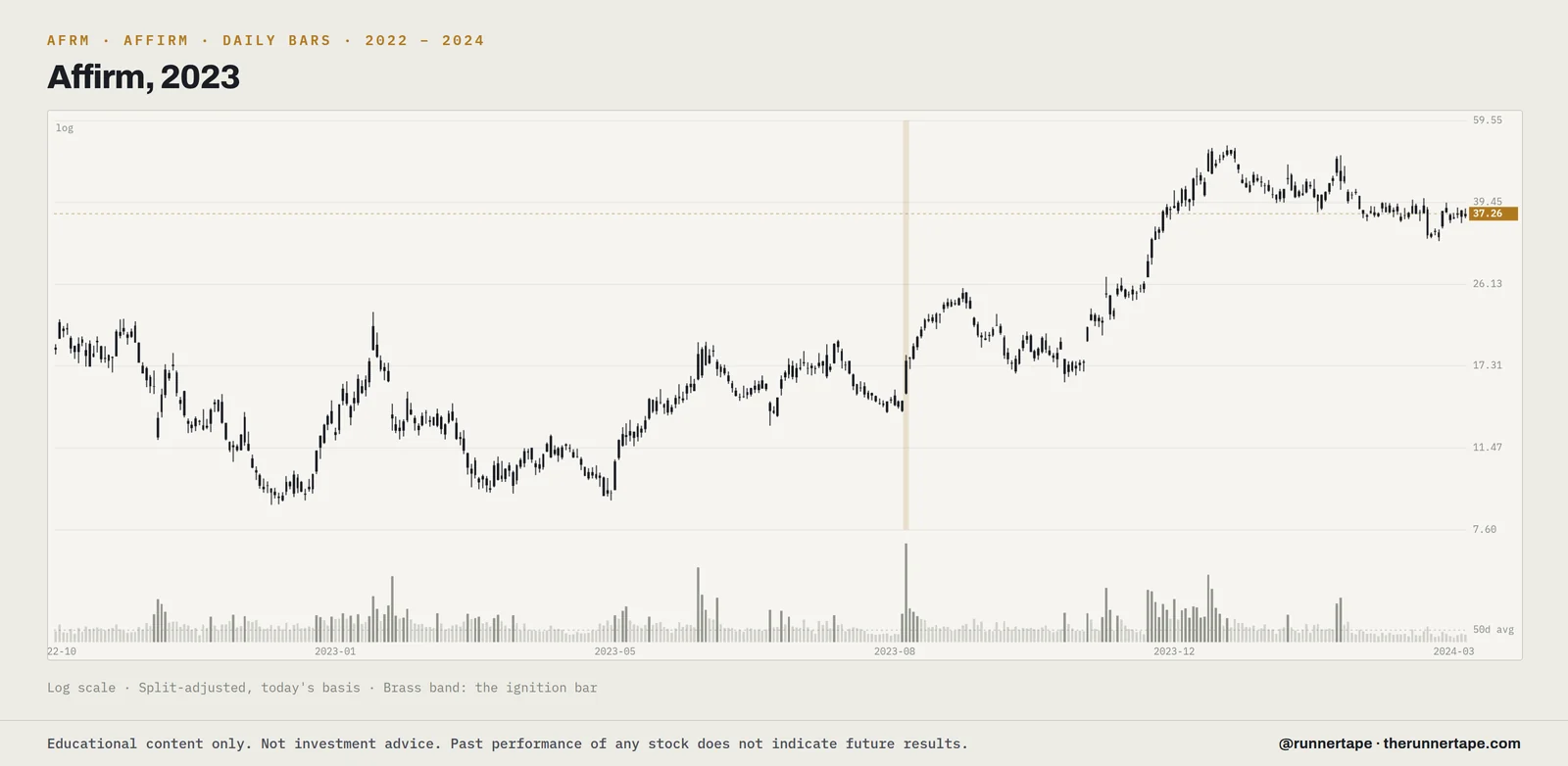
In 2022 shares of Affirm, the buy-now-pay-later lender, fell 89.8%, reaching an all-time closing low of $8.91 on 27 December. In the December 2022 quarter it posted an operating loss of $359.5M on revenue of $399.6M. Results for the June 2023 quarter, released on 24 August 2023, read differently. Revenue was $446M against estimates of $406M, gross merchandise volume rose 25% to $5.5B, and the loss per share was $0.69 against estimates of $0.85.
Adjusted operating income was positive, at $15M, and 30-day-plus delinquencies eased to 2.1% from 2.3% in the September 2022 quarter. The shares rose as much as 26% on the morning of 25 August. Revenue growth then quickened, to 37.3% in the September 2023 quarter and 47.9% in the December quarter, and the stock finished at +400% in calendar 2023. A year later the losses had turned: in the December 2024 quarter Affirm reported GAAP net income of $80.4M on revenue of $866.4M.
The full replay of this run, every bar with its catalysts pinned, is part of the members' library. Six classic runs are free now, opened by email.
Free: six classic runs
Sources: CompaniesMarketCap, Affirm price history · StockAnalysis, Affirm quarterly financials · CNBC, 25 Aug 2023 · Affirm IR, FQ4 2023 supplement. Price figures are split-adjusted, not dividend-adjusted.
The Runner Tape and its staff hold no financial or other interest, direct or indirect, in AFRM — no shares, no options or other derivatives, no compensation or arrangement of any kind connected with it — and have received no consideration from any person in connection with it being covered here.